
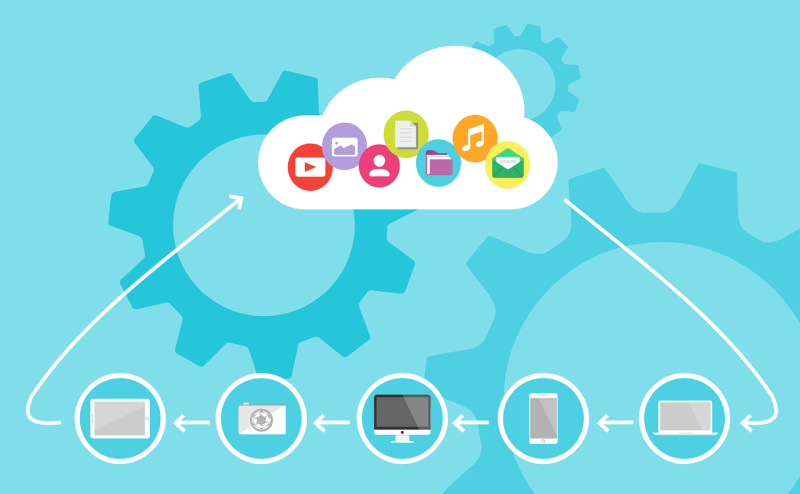
Cloud Computing – Cloud computing is the deployment of computing resources over the Internet. Cost savings, scalability, high productivity, economies of scale, etc. Offers For many companies, cloud migration is directly related to data and IT modernization.
When the phrase “cloud” first appeared in the early 2000s, it had an esoteric ring. The idea of accessing computing resources without an on-premise IT infrastructure (sky?) sounds like science fiction. The truth is profound and technology has changed the way we do business forever.
Cloud Computing

Cloud computing is the provision of computing resources, including storage, processing power, databases, networking, analytics, artificial intelligence, and software applications over the Internet (cloud). By outsourcing these resources, companies can access the computing assets they need to purchase and maintain the IT infrastructure they need. This enables flexible resources, rapid innovation and economies of scale. For many companies, cloud migration is directly related to data and IT modernization.
Introduction To Cloud Computing: Information Upload Types And Outline Diagram
Before cloud computing, organizations purchased and maintained basic IT infrastructure. While cost savings drove much of the initial shift to the cloud, many organizations are finding that public, private or hybrid cloud infrastructure offers many benefits.
Cloud computing providers provide APIs that allow users to acquire new resources or expand existing resources as needed. Teams can easily automate infrastructure provisioning with code tools like Terraform and Ansible.
Physical device placement is an important consideration when providing an optimal user experience. Cloud computing has had a major impact by providing globally distributed physical hardware that allows organizations to strategically provision hardware for location purposes.
Computing resources on a cloud infrastructure platform are dynamically allocated and allocated on demand. The physical machines of the cloud host are dynamically provisioned and shared among multiple tenants, fully optimized for maximum use of cloud hardware.
Cloud Computing In School And Its Benefits
Cloud infrastructure can scale up and down dynamically, allowing users to demand that computing resources automatically scale with traffic needs. The solution can be per-machine, where the allocation of resources is increased to increase the resources of the available machine, or an application is automatically extended to several networked machines.
Cloud infrastructure providers provide detailed metrics to report usage costs. For example, Amazon Web Services (AWS) provides usage on an hourly or daily basis for each service tier. Cloud service providers typically charge a metered and delivered utility-style fee, so users are billed for the exact amount of computing resources used.
There are three main types of cloud deployments. Each has unique benefits, and organizations often benefit from using more than one.

Public clouds share computing resources—servers, storage, applications, etc. Provides on the Internet. Cloud providers own and operate all hardware, software and other supporting infrastructure.
The Future Of Computing: Supercloud And Sky Computing
A private cloud considers resources dedicated only to one organization. It can be physically hosted in an organization’s on-premises data center or by a cloud provider. A private cloud provides companies with dedicated resources and more security and privacy than a public cloud.
Private cloud customers get the key benefits of public cloud, such as self-service, scalability and flexibility, but with the added benefit of increased control and automation. In addition, private clouds can have a high level of security and privacy because they are located on private networks that cannot be accessed by public traffic.
Hybrid clouds are a combination of private and public clouds (eg, IBM Hybrid Cloud powered by Red Hat) combined with technology that allows data and applications to work together. Sensitive services and applications can be hosted in a secure cloud, while public web servers and client-facing endpoints can reside in a public cloud. Most popular third-party cloud providers offer a hybrid cloud model that allows users to combine private and public clouds to meet their needs. This gives businesses more flexibility to meet application-specific infrastructure needs.
The dynamic features of cloud computing provide the foundation for new high-level services. These services are not only complementary, but can often provide the required services for agile and DevOps teams.
The Benefits And Challenges Of Cloud Computing For Small Businesses
Infrastructure as a Service (IaaS) is a cloud service layer that allows organizations to manage IT infrastructure – servers, storage, networks, operating systems – from a single cloud provider. IaaS allows users to back up and provision the resources they need from raw physical server storage. In addition, IaaS allows users to reserve preconfigured machines for specific tasks such as load balancing, databases, email servers, and distributed queuing.
DevOps teams can use IaaS as a core platform to build a DevOps toolchain, which can include the use of various third-party tools.
Platform as a Service (PaaS) is a cloud infrastructure built on IaaS that provides resources for building user-level tools and applications. It provides basic infrastructure such as computing, network, and storage resources, as well as development tools, database management systems, and middleware.

PaaS uses IaaS to automatically allocate resources to run language-based technology suites. Popular language technology stacks are Ruby On Rails, Java Spring MVC, MEAN and JAM stack. PaaS customers can then upload application code artifacts that are automatically deployed on the PaaS infrastructure. This new and powerful workflow allows teams to fully focus on specific business application code and worry about hosting and infrastructure concerns. PaaS works automatically by scaling and monitoring the infrastructure to increase or decrease resources with controlled traffic load.
What Is Cloud Computing
Software as a Service (SaaS) provides software applications on an on-demand basis and usually by subscription. Cloud providers host and manage the software, applying software updates and security patches as needed. Examples of SaaS include CRM systems, webmail applications, productivity tools such as Jira and Sangam, analytics tools, monitoring tools, chat applications, etc.
FaaS as a service (FaaS) is a cloud computing service that provides a platform on which customers can develop, run, and manage applications. This reduces the need for developers to build and maintain the infrastructure needed to develop and launch the app. Cloud providers provide cloud resources, execute a group of code, return the result, and then destroy the used resources.
The unique features of cloud infrastructure provide many new technical and business advantages. Following are the main benefits of cloud computing for agile teams.
Teams using cloud resources do not need to purchase their own hardware. In addition to hardware costs, cloud providers do their best to maximize and optimize hardware utilization. This puts hardware and computing resources at risk, and cloud providers compete to offer the bottom line.
Benefits Of Cloud Computing For The Supply Chain
Because cloud computing is flexible by default, organizations can scale resources at will. Creates autoscaling features for cloud computing teams. Cloud applications can automatically scale infrastructure resources in response to increased traffic.
Cloud computing offers the latest and greatest computing resources. Users can access modern machines with extreme, multi-core CPUs designed for heavy parallel processing tasks. In addition, major cloud providers offer the latest GPU and TPU hardware for powerful graphics, metrics and artificial intelligence processing. These cloud providers are constantly updated with the latest processor technology.
Major cloud computing providers have globally distributed hardware that provides high-performance connectivity depending on the location of the physical connection. In addition, cloud providers offer global content delivery networks that cache content based on user preferences and location.

Teams using cloud infrastructure can execute faster and deliver value to their customers. Competing software teams can use cloud infrastructure to accelerate spinning up new virtual machines to test and validate unique ideas and automate the testing and deployment phases of the pipeline.
What Is Cloud Computing? An Overview Of The Cloud
Private cloud hosting offers a separate secure infrastructure that enhances security. Additionally, cloud providers offer many security mechanisms and technologies to help create secure applications. User access control is an important security concern, and many cloud providers offer tools to limit granular user access.
Continuous integration and continuous delivery (CI/CD) are key practices for DevOps practitioners that help improve team speed and reduce time to market. Cloud-based CI/CD allows Bitbucket Pipelines to automatically build, test and deploy code without having to worry about managing or maintaining CI infrastructure. Bitbucket pipelines rely on Docker containers to provide isolation and replication of the release pipeline. Teams can run the same commands as they would on a local machine, but with all the benefits of a new and reproducible configuration for each build.
Cloud tools allow teams to connect their tools end-to-end, making it easy to monitor all parts of the pipeline. Extensive monitoring is another key feature for organizations that implement DevOps, as it enables faster resolution of issues and incidents. Cloud providers monitor system health, including application and server CPU, memory, application speed, error rate, average response time, etc. For example, load monitoring across multiple virtual machines (VMs) means teams can add more if demand increases, or teams can automate scaling (up/down) based on these metrics to reduce human intervention and costs. for the. Read more about DevOps monitoring.
Cloud computing provides advanced computing
What Are The Security Risks Of Cloud Computing?
Cloud computing threats, hybrid cloud computing, gpu cloud computing, cloud computing services, cloud computing security services, cloud computing and security, cloud computing degree, online cloud computing degree, cloud computing service, ibm cloud computing, private cloud computing, cloud computing companies


